Friday, June 4, 2021

A statement about the Wesley College Acquisition

Delaware State University is actively taking steps to acquire our neighboring institution of Wesley College. If all proceeds as planned, Wesley College will cease to operate as an independent institution, and will instead serve as Delaware State University's satellite campus for the College of Health and Behavioral Sciences.

I wish to acknowledge that because this is not a merger, there are inherent fears on the part of our Wesley colleagues and students.  More specifically, Wesley College alumni have expressed anxieties about how their collective identity and legacy as proud Wolverines is being impacted. Wesley alumni - Your history will not be forgotten. I hear you, and I share in your passion for your alma mater's history. 

At this time DSU and Wesley continue to operate as two distinct and separate institutions until the acquisition is legally affirmed. I would love to jump in and start working to preserve Wesley College's records and institutional memory, but I must remain at a distance. Nevertheless, I wish to allay your fears. Current Wesley College employees, from the library, alumni relations, athletics and others, are on a mission to gather the historic papers, photographs, artworks, and more. Allow me to definitively say that after the acquisition takes place, the records of Wesley College will be incorporated into the Delaware State University Archives.  For the first time ever, Wesley documents will receive the preservation treatments they so richly deserve under the direction of a professional archivist. 

If you are a member of the Wesley family, please don't hesitate to reach out to your current library staff to learn more about the initiatives happening on your campus.  After the acquisition is finalized, I too will be standing by to answer questions and ready to welcome you into the university archives.  I am so excited about the next chapter of the archives journey and meeting all of you!

Until then,

Rejoice

Friday, March 19, 2021

Final Mixx

Every weekday for six years I have come to work at the William C. Jason Library and never known that I was in the presence of musical greatness!  Sure, I occasionally heard our library assistant, Mark Harris, share stories about his band from back in the day. I knew his band had been popular, but it wasn't until I digitized the Hornet newspapers (now available online) that I realized just how BIG of a deal the band was. 

While attending Delaware State College in the mid 1980s, the Final Mixx band came of age and attained a name for itself among by touring the residence halls on the DSC campus. After gaining popularity with students, they eventually picked up gigs in the clubs of Dover, broader Delaware and New Jersey.  After graduation, the band members decided to stay in Dover in order to have a shot at fortune and fame as a professional band. Their opportunity eventually came in the form of Budweiser Showdown. Watch Final Mixx at Club Illusion in Dover, DE


Throughout the 1980s, Budweiser sponsored regional talent contests to locate up and coming Black music artists. The winners of the five regional competitions were then invited to perform at a national competition with a cash prize and a record label deal.  In 1989 Final Mixx entered a regional contest in Philadelphia and won! 

It's July 21, 1989 at the Hoosier Dome. There are 10,000 people watching. Spike Lee, Sinbad and El Debarge are in the audience. Standing in front of all of them are the members of Final Mixx, Mark Harris, Tracey Hazzard, Marty Denson, Derrick Williams, Vincent Adkins, Reuben Fountain and Richard Wright ready to give the performance of their lives. The band performed four songs, left the stage and assumed they hadn't won. 

In a stunning moment backstage, the band was hanging out and did not initially realize that Final Mixx had been declared the winner. With a little bit of prompting, the band rushed the stage to accept a $10,000 cash prize, musical equipment and a deal with Motown records. Watch a promo for Budweiser Showdown featuring the moment Final Mixx won.

While you can find the LP from the Budweiser Showdown in online marketplaces, unfortunately the band didn't go on to record an album and was all but forgotten by Motown Records. Final Mixx, has not, however, been erased.  Their story is forever preserved in the Hornet student newspapers.  Next time you are in Professor Denson's music class or chat with Mark Harris at the library front desk, be sure to ask them about the time they performed for 10,000 people!


Wednesday, February 17, 2021

Hornet Student Newspapers Now Available Online


The Hornet student newspapers are now accessible online! 

All of the newspapers held in the archival collection have been digitized and uploaded to the University Archives' DSpace digital repository. The earliest papers date to 1929 and 1947. There are a handful from the 1950s and 1960s but from 1970 until 2015 the collection is nearly comprehensive.  Please note that after April 2015 the paper became digital in format and can be found here. 

Digitizing the Hornets has been a thoroughly enjoyable project. For starters, I have discovered images of many of current university employees as college youths...you can't image the bad hair or funky fashion pictures that I now have. Just kidding.  

Second, I have become reacquainted with the college-age imagination, idealism, and snark. Who doesn't enjoy reading interviews with Mr. D. Par Kinglot or headlines such as "Lecterer bores, Student snores?" Aaaah the good old days when our biggest problems revolved around what the cafeteria was serving, athletic rivalries, and elections for the next student government president.  Joking aside, next to these humorous commentaries, you will find serious articles that prove DSC and DSU students were passionate about politics, fearless in tackling controversial topics, and well-versed in contemporary culture through poetry, plays, and concerts. Duke Ellington, Muhammad Ali, and numerous internationally-renown piano virtuosos toured on our campus!!

I hope that you, the alumni, enjoy reading about, and reliving, fond college experiences. As always, don't be shy about sharing your memories. Comment below or email me. I love hearing them!

Monday, February 1, 2021

#ColorOurCollections 2021


It's national #ColorOurCollections week! Each February museums, libraries, and art institutions across the country release coloring book style images of artworks from their collections. This year the DSU archives brings you a drawing by Eugene Irving that first appeared on the cover of the Hornet student newspaper in February 1982.  Mr. Irving served as a Hornet staff photographer before completing a civil engineering course of study in 1983.  Happy coloring! 


If you want to check out some other coloring pages head over to the Color our Collections webpage hosted by the New York Academy of Medicine: https://library.nyam.org/colorourcollections/

Monday, December 21, 2020

Annual Christmas Letter, 2020


 Dear Friends, 

No need to tell you what a year it's been as we have all faced challenges and insecurities. As we close out this year, I hope that each of you is well and looking forward to the future. 

2020 started out as a great year as the project to digitize the course catalogs was progressing smoothly. I had just finished uploading them to DSpace when the library team started to get the feeling that something was coming. The week before Delawareans were given stay-at-home orders the library team dropped everything and hustled to produce a series of YouTube tutorials demonstrating our virtual services and live chat. After a well-deserved weekend we suddenly found ourselves on our couches asking, "what now?" We thought that by the Easter season we'd be back in the office, but that possibility became bleaker. As an archivist without anything to archive a slow month quickly became a slow year.  Some of you were able to send reference requests that were able to be fulfilled long-distance, and for that I was grateful. The value of having things digitized became apparently clear during this time. 

This past fall we were able to return to the library two-days a week. When I came to my office for the first time in many months, I found everything exactly as I had left it...half finished. Piles of paper were spread out across the room.  The stacks were separated into some sort of order that had once made sense to me, but that I was then straining remember.  Why didn't I make notes? It took me a few weeks to review it all and reorganize it. During those endless spring and summer days at home I had been looking forward to once again making progress, but now I found myself with the odd sensation of moving backwards. With perseverance I eventually dug out my desk and found the bottom of my conference table. 

At the beginning of this month, hope was once again in sight. Digitization projects have resumed! You can expect to see the Hornet newspapers (dating from 1928 to 2015) hitting our DSpace repository in early 2021. It is a relief to once again have a goal and see progress being made.  Nothing makes me happier in my work than the manifestation of a new collection or resource. Speaking of "new", next year promises to be a significant milestone as we anticipate the acquisition of Wesley College and all of its records. Exciting adventures into unchartered territories are ahead! 

I hope that you too are looking toward a brighter 2021, and I hope that you feel the warmth and peace of the Christmas season. Merry Christmas! I'll see you again next year. 

Love, 

Joy

Me and Busy, my coworker for 2020


Monday, October 12, 2020

Accessing the archives during COVID-19


Hey Friends! I hope you're all safe and well.  The William C. Jason Library is open to the campus community on Monday, Wednesday, and Friday. The University Archives, specifically, is open on Monday and Wednesday.  As always, I am eager to assist you in whatever capacity I can, however, I must beg your patience and make you aware of some protocol:
  • If you are a university community member, and need to access archival collections I ask that you email me (rscherry@desu.edu) well in advance to schedule a visit. This is necessary to ensure that the appropriate health and safety arrangements have been undertaken.  
  • If you are an alumni or member of the public, please email me to determine how I can best assist you.  In most cases, I will conduct research on your behalf and provide a limited number of digitized records pertinent to your request. 
  • Please be aware that myself and my fellow librarians are working remotely on the days when the building is not open.  Toward that end, we are not reachable by office phone. Email is the best method of communication (rscherry@desu.edu). 

While COVID-19 may seem like a significant barrier to accessing the archives, it can also be a benefit.  For example, I recently had a request for records of the 1968 student unrest.  In meeting the patron's needs, I was actually able to upload the 1968 unrest collection to our digital repository (https://desu.dspacedirect.org/handle/20.500.12090/345).  So while I share your frustrations, I am also pleased to be able to increase our digitized collections.  I hope that you will enjoy exploring the new records. 

Thursday, May 14, 2020

Collection Spotlight: Eula Maloy Oliver collection


This month we are showing off another tiny, but fascinating, collection at the Delaware State University Archives.  Like the Viola Young Scrivens collection highlighted last month, The Eula Maloy Oliver collection is small in stature, but it is representative of an era in DSU history that is not well documented.  

Beginning in the late 1950s Eula Maloy Oliver attended the DuPont High School, more commonly referred to as the laboratory school on the campus of Delaware State College.  After completion of the high school division, Eula continued her DSC education at the collegiate level.  She attained a bachelors degree in education in 1962. While in attendance, Eula was very active socially and became a member of the then-newly established Delta Lambda chapter of Alpha Kappa Alpha Sorority.  Eula also married one of her classmates, William A. Oliver.

The Eula Maloy Oliver collection is a treasure trove of black and white photographs depicting 1950s Delaware State College.  The subject matter ranges from campus scenery to athletics, to student organizations and more. The individuals most commonly shown are Mr. and Mrs. Oliver and their mutual friends. The images found here are just two examples: Above - two female students promenade on the campus circle, a popular spot for croquet games and relaxation, and a hangout for the children of faculty members. Below - Students typically enjoyed dancing and card games in "the canteen" located in the basement of Conrad Hall.  The canteen was one of the few social locations on campus where male and female students could enjoy time together. Dorm visitations at this time were very strict.

Other contents in this collection include a 1952 Dupont High School yearbook, a 1962 DSC yearbook, and a letter written by Eula to Dr. Claibourne Smill dated November 9, 2005 in which she addresses concerns for the further expansion of the campus and maintaining a diverse student population.

Through her DSC degree, Mrs. Eula Oliver was employed as an elementary school teacher for 35 years. She was an influential individual in Delaware Education and served on a great number of local, state, and national committees. Perhaps most significantly, she worked to formulate the Delaware State Assessment Standards in the areas of math, science and social studies. 

Mrs. Oliver had two sisters who additionally attended Delaware State College, Mrs. Mary Scott and Mrs. Bertha Turner. Please note that Mrs. Scott also has an archival collection of photographic scrapbooks available for public viewing.  


Thursday, April 9, 2020

Collection Spotlight: Viola Young Scrivens collection

Today I am spotlighting a collection that could easily be undervalued and overlooked in the Delaware State University archives. The Viola Young Scrivens collection is tiny at a mere 0.25 linear feet, but it holds contents for an era of DSU documentary history that is not well represented by other photographs and records. 

In 1933 Viola Scrivens was a high school student at the laboratory high school on the campus of the State College for Colored Students.  Although she had a long association with the college, she did not pursue a collegiate education.  Beginning in the 1940's, Viola did, however, serve as a cook for  Delaware State College, and she seems to have been an active alumna and member of the campus community. Her collection therefore contains event programs for student theater productions, concerts, building dedications, and Founder's Day events dated between 1931 and 1983. 

Alumni play a valuable role at Delaware State University and are sincerely appreciated by administrators and students alike.  Alumni, as always, are welcome to donate any documentary evidence of their collegiate experiences to the archives.  The students who conduct research at the archives are always eager to learn how their experiences differ from their predecessors, and they value the life lessons that are often by only be conveyed through the archival collections curated by alumni. 

A full description of the collection is available as a finding aid on the DSU archive's LibGuide: https://desu.libguides.com/ld.php?content_id=34904850
A 1931 program for a twelfth grade play. 

Viola Young Scrivens' card of admission for the SCCS
laboratory school. Click to enlarge the image.

Tuesday, January 28, 2020

Course Catalogs now online

The DSU archives' online repository is continuing to grow!

This month marks the completion of yet another collection in DSpace. All of the course catalogs housed in the University Archives, 95 in total, have been digitized and made publicly available. It is hoped that the online catalogs will be a resource for alumni and university departments alike who need to access historic degree requirements and course descriptions.  Additionally, the digitization of the course catalogs is a helpful step as the university prepares for the Middle States re-accreditation process.

Besides the obvious purpose of outlining educational requirements, the course catalogs also reveal a picture of the university as it once was.  The catalogs, dated between 1893 and the current academic year, are a wealth of historic information about faculty employment, calendars, campus infrastructure growth, academic and student life regulations (rules that seem comical today), student clubs and social activities, athletics, and support services. In my opinion, the catalogs have long been undervalued, and it is my hope that the new, digitized format of the catalogs will make them more accessible and better appreciated. Take a look for yourself here: https://desu.dspacedirect.org/handle/20.500.12090/399.

This month marks the end of the first year in the digitization effort.  All in all, there are now 131 volumes of yearbooks and catalogs available. It has been a transformative year  as reference questions involving these materials are being answered with greater speed and in many cases, patrons are discovering independence in pursuing their interests.

But wait! There's more! Be on the lookout for digitized Board of Trustee minutes to start appearing soon. 

Tuesday, January 14, 2020

Partnering with the Delaware Historical Society to examine Unequal Justice in DE

Happy New Year! This week we are welcoming our students back and settling into new classes and routines. As I look forward to another exciting semester, I would like to announce an ongoing partnership between the Delaware Historical Society, University of Delaware and of course Delaware State University.  We are embarking on a journey to shed light on unequal justice and other disparities experienced by the African American community in historic Delaware.

We are actively seeking to define our project in terms of era and scope, but our purpose is to tell the story of lynchings, riots, and other racially charged events perpetrated against African American Delawareans. A small piece of the project will focus on educational disparity and segregation in the schools. While DSU has faculty and staff from numerous professional disciplines participating in the project, the examination of education will be my primary contribution.

Alumni, if you would like to contribute to the project or have a story you would like to share with us, please reach out to me at rscherry@desu.edu.  Alternatively, you can contact the Delaware Historical Society through Stephanie Lampkin at slampkin@dehistory.org.

The following is the official press release from the Delaware Historical Society:

Partnership Formed to Research Unequal Justice in Delaware
Wilmington, DE– A project to unearth the forgotten and unknown instances of unequal justice in the First State is underway through the Delaware Historical Society’s Jane and Littleton Mitchell Center for African American Heritage, the University of Delaware, Delaware State University, and the Delaware Social Justice Remembrance Coalition.
The project, “Unequal Justice in Delaware – Rewriting the Narrative,” will explore the history of racial violence, remembrance, and social justice throughout Delaware’s history and across all three counties.  The project will merge rigorous academic research from various higher education departments with grassroots community engagement and activism. 
“The University of Delaware is extremely excited to be a partner in this important project,” said James Jones, Director of the University’s Center for the Study of Diversity, which is coordinating UD’s participation.  “The talent, dedication and expertise of our community is a natural and important source of support for this valuable effort to better understand Delaware’s racial history and to raise awareness and implement reforms to guide us toward a more just society for all Delawareans.”
Support for the project at UD, said Jones, will include the Provost, and broad engagement from faculty, students and staff in the Morris Library, Africana Studies, History Department, Department of Sociology, Office of Community Engagement, School of Education, and the School for Public Policy and Administration.
The stories revealed through research and public engagement events will be brought to light through oral and digital histories, as well as curriculum development.  The project will also explore how research and public engagement can inform policy.  It is inspired by Bryan Stevenson’s groundbreaking work with the Equal Justice Initiative in Montgomery, AL.
Wide participation is also planned at Delaware State University (DSU), said Dr. Akwasi Osei, Associate Dean of the College of Humanities, Education and Social Sciences and Director of the Global Societies.  “This joint effort on Delaware History will bring together faculty, staff, students, and others to contribute to the further edification of all of Delaware and the nation,” said Dr. Osei.  “It will go to show that despite our current ‘tribalism,’ we have always been in this together, and will continue to be.”
Dr. Osei said the project will help tell the American story. “That magic moment, well over two hundred years ago, when we declared the basic humanity of all is perhaps the greatest moment in that history,” he said. “That we have to ‘rewrite’ the narrative of the actual unfolding of that story is indicative of how rocky the journey has been.”
The partnership also includes the Delaware Social Justice Remembrance Coalition. “The Delaware Social Justice Coalition (DSJC) is thrilled to be a part of this collaborative that will continue the work of illuminating and memorializing past incidents of racial terror in the state of Delaware,” said Amy Shepherd, an officer of DSJC.  “We appreciate our state's willingness to understand how such incidents have impacted life as we know it today and we look forward to Delaware's propulsion toward becoming a leader in changing the narrative around race and poverty, as Bryan Stevenson urges.”

A website for the project is currently under development, which will be essential for the progress of the historical initiative and dissemination of the narratives it yields.
For questions about the project, contact Stephanie Lampkin, Director of the Jane and Littleton Mitchell Center for African American Heritage, at slampkin@dehistory.org.

Saturday, December 7, 2019

Annual Christmas Letter 2019

Dear Friends,

It's that time of year again!  I hope that 2019 was a happy, healthy, and productive year for each of you. Can you believe that we are rounding the corner on a new decade?

As I reflect on this past year, the first thing that comes to mind was the tremendous loss that the university experienced in the passing of former president, Dr. William DeLauder.  I am sure that this holiday season will be difficult for his family, and I wish them to know that they are in my thoughts. I was honored to have met Dr. DeLauder several years ago, and I am eternally grateful for his  donation to the archives.  Included in his donation were some Board of Trustee minutes that are highly valued.

The second thing that comes to mind is the outstanding progress that has been made in the digital realm. Amazingly, 113 volumes of yearbooks and course catalogs have been digitized in 2019 and we're not done yet! In the next few days before the holiday you can expect to see several more catalogs hit the web.

The number of reference interactions in 2019 was up by 23% from last year! This is a significant increase, and I am so delighted to have met so many new faces.  Our constituents continue to be representative of a diverse population. This year's patrons included individuals from Dartmouth College, US Fish and Wildlife Service, Delaware Historical Society, University of Colorado, University of Maryland, New Jersey State Library, Phoenicia Public Library, and of course all of my favorite alumni, administrators, and students. It is my pleasure to serve you.

What will next year hold for the archives? For starters, it will be a new year under a new president. When we return to campus on January 6th we will welcome Dr. Tony Allen as our fearless leader. Second, I am looking forward to using my organizational skills on behalf of the university for a very exciting and vital committee assignment. Third, I hope to continue to expand the digitized collections by moving on to the Board of Trustee minutes. Whatever happens in 2020 I hope that you will continue to join me on this journey.

I wish you a Merry Christmas and desire all the best for you in the new year.

Cheers,
Joy

Tuesday, September 10, 2019

New Athletics Exhibit Open


In keeping with tradition, the archives kicked off the new school year with by installing a new gallery exhibit.

The focus of this year's display is Delaware State University's vibrant athletics history. It features athletics artifacts and photographs spanning from as early as 1950 through the current day.  Archival photographs represent our oldest history while more recent history is represented through signed jerseys, game balls, and other paraphernalia on loan from the athletic advising department. The room is additionally festooned with historic pennants from the Prettyman family collection.

I invite you to come view the exhibit. The gallery is open during library hours of operation from 8:00 am until 12:00 am Monday through Thursday, 8:00 am to 5:00 pm on Friday, 12:00 pm to 5:00 pm on Saturday, and 2:00 pm to 10:00 pm on Sunday. See you soon!

Tuesday, September 3, 2019

Archives Artwork in the New Dorm

Strips of Hornet newspapers
make up this wallpaper
Hello Archives Friends! You may have seen the university's recent Facebook posts about the opening of Tubman Laws Hall or the flikr images from move-in day. If you have, you've seen a beautiful, modern, comfortable space for students to live, study, play, and relax.  Did you know, however, that the university archives made significant contributions to the interior decor?

For a year and a half, I worked to provide a design contractor with archival materials. The archival images, historic slogans, vintage hornet, and Hornet student newspapers were transformed into unique interior decor features.

The most obvious feature is a mural of significant university figures and buildings. For the students walking by, the mural looks like an awesome collage of hand-drawn figures.  To me, and maybe my astute patrons, however, I can pinpoint specific photographs that helped to create this work of art. Additional features include wallpaper in the mailroom which is made from strips of Hornet newspapers, framed black and white images on the walls, a historic campus map framing the bricks and cornerstones from Tubman and Laws, and the vintage Hornet mascot that graces the wall behind the front desk in the entry way.

I never got to see the mock-up art before its final installation, but I'm glad.  It was far nicer to be surprised by the final product.  In the end, this is yet another way that the archives is making its presence felt on campus and contributing to the university.


Do you see this barn and tractor in the collage below? 

Monday, August 26, 2019

Collection Spotlight: DSC Sports Photographs, 1945-1965


Hello friends! I hope you’ve had a wonderful summer.  Classes resumed this week, and August is quickly passing. It’s been a while since I featured a collection so I thought I’d shine the spotlight on the Delaware State College Sports Photograph collection, an acquisition from January 2017.

This collection is comprised of black and white sports photographs from the era of Bennie J. “Catfish” George.  Mr. George was an athletic coach and physical education teacher at Delaware State College starting in the 1950’s and continuing well into the 1960’s. Mr. George held a bachelors degree from DSC (1947), and during his time as a student he was captain of both the football and basketball teams.  Due to his quick, "slippery" moves on the football field, he ultimately earned the Catfish moniker.  Two years after graduation, Mr. George's athletic performance earned him an appointment as the assistant football and basketball coach, and head baseball coach.  Over his men's basketball coaching career, he attained a record of 360 wins and 125 defeats with only two losing seasons in a 30-year period. Mr. George was named coach of the year for baseball (1954), football (1956), and basketball (1966) in the CIAA conference.

Given the significance and formidablity of Bennie George's career, it was therefore thrilling to receive a collection of men’s basketball, baseball, football, and fencing photographs dated between 1945 and 1965. This accession additionally fills the sizable gap in the Office of Public Relations photographs which are largely from 1960 and later.

As always, I invite you to visit the archives to view this and other collections. Give me a call at 302-857-6130 to set up an appointment. I hope to see you soon! 

Tuesday, August 20, 2019

Welcome back students!

It's a big week from Delaware State University! The faculty and staff are looking forward to welcoming the incoming freshman starting tomorrow and the upperclassman later this weekend.  Campus will be buzzing as students either make new friends or get reacquainted with their classmates.

Over the next few days they will be settling into their residence halls, and some of them will have the pleasure of being the first-ever residents of our newest hall (word around town is that it will be called Tubman-Laws, but we'll found out during a dedication ceremony later this semester). 

For those of you will be embarking on a shopping excursion with your roomate or suitemates, I thought you would enjoy some inspiration from these archival photographs.

1) Chic Curtains: These circa 1990s Medgar Evers residents must have had some help from their moms or girlfriends. Either way, I'm diggin' the matching bedspreads and curtains.

2) Statement furniture: When confronted with bland white walls and standardized furniture, nothing brightens up a college dorm like a comfortable chair. It makes those long study nights a little more bearable. Houseplants are also a must. 

3) Pictures of Home: No room would be complete without a picture of mom. It's nice to have a reminder of those who love you and who are supporting you in your journey. Don't forget to say thank you.

3)Homey Bedspreads: Okay so this one isn't actually a dorm room. It's the home economics practice house, but all the same, it's something to aspire to.  A bedspread is one of the most personal statements a student can make. Don't forget to make it in the morning.


From the staff of the William C. Jason Library, I wish you the best of luck this semester!  Don't forget that we are always here to support your research and to help you become a better scholar. See you soon! 

Tuesday, July 30, 2019

Digitization continues

Hello everybody,

A quick update about the DSpace digital repository- I'm moving forward with a second collection!  Back in February I completed the digitization of the yearbooks and I watched to see how the community would use them.  I'm happy to say that these digital resources have been a game changer for both administrators and alumni.  Both constituent groups are able to independently conduct research.

I am now advancing the digital repository further by adding course catalogs. The catalogs describe not only the courses of study and credit counts, but also the physical campus, faculty credentials, expenses, rules for students, and social activities. In the case of our earliest catalogs, there are also annual reports from the president.

As of today, there are 25 course catalogs uploaded to DSpace.  The digitization of the catalogs is currently ongoing and the content will be uploaded as it is created.  Check back regularly to see new additions to the collection.  https://desu.dspacedirect.org/handle/20.500.12090/399

Yours,
Joy

Monday, July 22, 2019

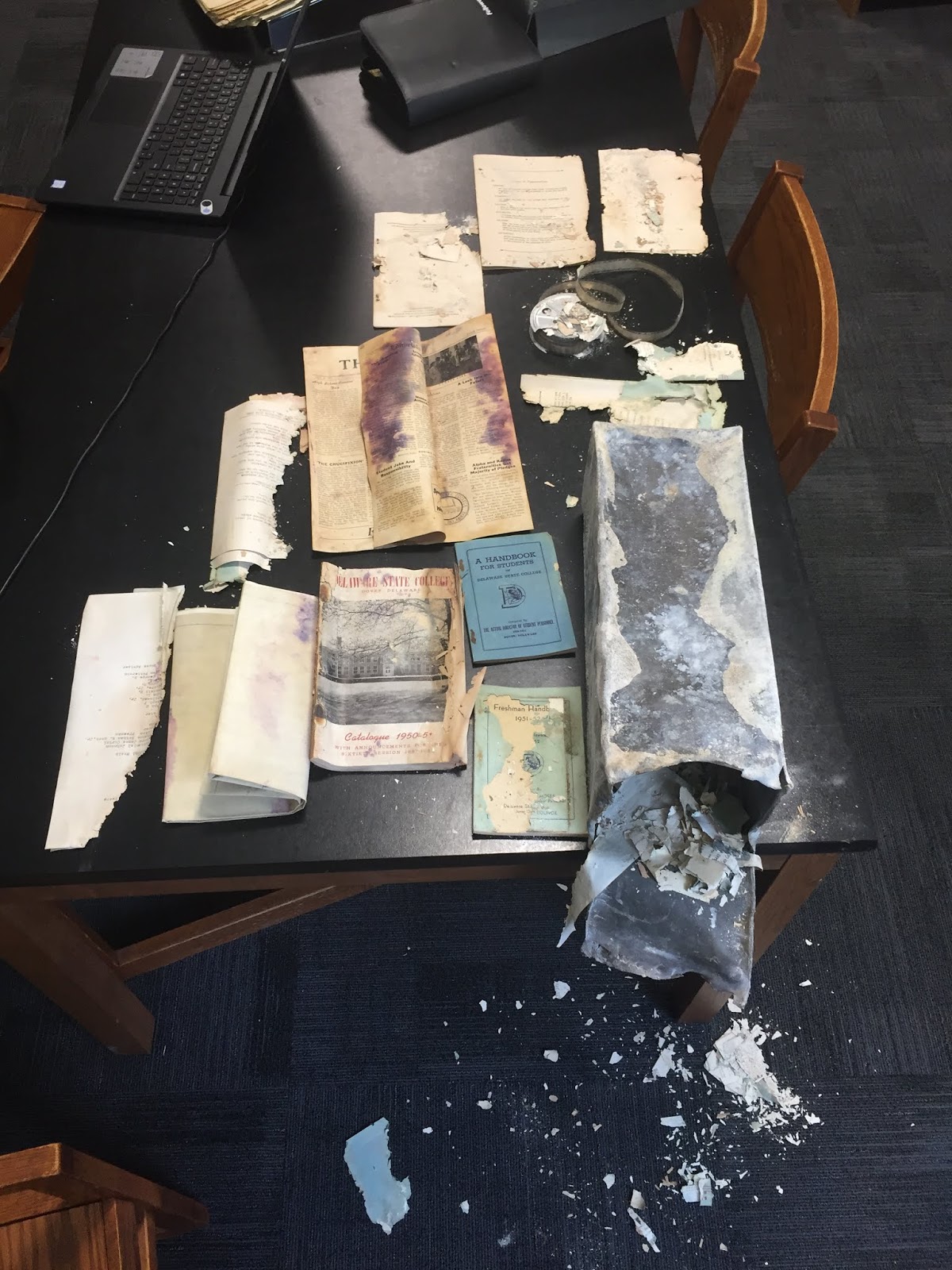
Tubman Hall Time Capsule Opened

As Tubman Hall was demolished this summer a time capsule was removed from the building's cornerstone. A few weeks after, I found myself standing alone in my office with hammer in hand, poised to pry open the box.  Remember the guy in Indiana Jones whose face melts when he gazes upon the arc of the covenant? That's what I was thinking about. I wondered what form of boogieman might pop out.

Unfortunately, the box was one giant disappointment.  Not only were there no monsters, but the paper disintegrated and any secrets contained within were permanently lost.  It was not difficult to guess what happened.  When I first looked at the led capsule I noticed a pinhole in one of the corners.  In fact, I used that weak spot as the starting point to pry it open.  Significant moisture must have leached into the box through the hole and destroyed all of the contents.  The paper did not bend or fold as one would expect.  Instead it crumbled at the slightest touch.

When I first peered into the box the papers looked whole. Within a the span of just a few blinks of the eye, however, it looked like a confetti bomb had deployed in my office.   The first item that I removed, a small booklet, exploded in mid-air and fluttered to the ground.  I never even had a chance to read it.

Regrettably, the vast majority of the contents ended up in the library cleaning lady's vacuum cleaner where it is forever lost to me. A reel of film was easily identified, but the emulsion that held the images onto the film was washed away. I was able to salvage a few items - an architectural drawing of campus, a high school dance recital program, a 1951-1952 freshman handbook, a 1950-1952 student handbook, a program from the laying of the Tubman cornerstone, and an Omega Psi Phi fraternity "Trusting Hearts" event program.

If you are interested in viewing the time capsule content I would be happy to email you the scans or photographs that were captured for each item. Please note that due to preservation concerns, access to the physical items is restricted.


Monday, June 17, 2019

Goodbye Tubman Hall

Tubman Hall in 1977. Named for Harriet Tubman, the building was three stories with a 108 bed capacity.  Although it served both male and female students across its lifespan, Tubman was primarily home to female freshmen. 
Last summer we "turned the lights out" at Laws Hall in order to start the construction of a new 620-bed housing facility. As the academic year passed we watched the building grow to a stature we never imagined and at a rate we could hardly believe.

This summer we are saying goodbye to yet another residence hall. Just days after students moved out of Tubman Hall, the construction workers moved in and began demolition.  The building must be removed in order to make way for the second section of the new facility (projected to be completed in August).

Personally, I am sorry to see Tubman Hall go.  Unlike many of you, the alumni, I do not have sentimental attachments. However, for me, Tubman was symbolic of this our predecessors' perseverance and faith in the future. Tubman was built at a very uncertain time in DSU's history.  In 1949 the institution lost accreditation and was immediately thrown into turmoil.  Most significantly, there were talks of merging Delaware State College with University of Delaware.  Tubman was constructed in 1952 despite  tremendous uncertainty.  The very fact that Tubman was constructed, and with state appropriations, tells me that there were individuals with confidence in the college.

Sixty-seven years later, Tubman has served its purpose.  It was a voice for the future and it got to be a part of the drastic growth at Delaware State College. Today Tubman must bow out in order to allow the current generation to make new assertions for the future. Even as it closes its doors, Tubman remains a symbol of the aspiration and foresight of our leadership.

Did you live in Tubman? Do you have any fond memories? Comment below.


Left:Tubman Hall in the initial stages of demolition, May 22,2019.  Right: Phase I of the new dormitory under construction

Monday, June 3, 2019

Book Binding School

Last month I attended a book binding workshop in order to learn how to replace and rebuild a hardcover. It was much more intense process than I ever imagined. Before beginning the workshop I thought, perhaps like you, that a cover was simply cloth-covered cardboard that is glued to paper pages. I couldn't have been more wrong! There are so many more components - bookcloth wrapped around binding board, peach board, paper tubes, endbands, ribbon bookmarks, two different kinds of tissue paper linings, paste, glue, and fabric.  Making a book also requires numerous tools including two kinds of presses, board shears, two kinds of scalpels, and rulers and other measuring devices just to name a few.

My introductory education into book binding was a two-day process in which an instructor demonstrated the techniques and tools required. By following along, I was able to repeat these steps on a book of my own.  By the end of the workshop I had completely rebuilt my book and made it stronger than ever.

A result of my education was a deeper understanding of how the construction of books affects their preservation.  For example, when applying the book cloth to the binding book (ie the outer most layer of the cover) I folded the fabric incorrectly resulting in a small bulge at the corner of the cover.  In the future that bulge will likely result in a hole in the cloth because of the increased friction as the book slides on and off a shelf. It is this level of minutia detail that I was previously unaware of and did not know how to look for. I believe that this workshop will make me a better archivist as I continually seek to preserve DSU's collections. It may also inspire a new hobby.

My book was stripped of its original cover and all of the
glue and linings that held it together. Here it has been
reduced to the text block which is held together only by stitching.

After a new cover was measured and cut, my book was placed in a
nipping press where it was "trained" to form the
characteristic dip or crease between the spine and the covers. 

In addition to building a cover, I also learned to set type
in order to print the gold leaf title for a spine label.