2018 marks the 50th anniversary of a series of student-led demonstrations that rocked Delaware State College. I could not have let the year go by without mentioning the historical moments that continue to be among those most widely discussed and debated.
Please note, as an archivist, I am predisposed to base my research in the documentary evidence of the past. Written word does not have a fallible memory. In this case, however, to rely purely on paper would result in a one-sided story because the majority of DSU's archival records are created by administrators. In order to hear the students' voices I had to have a conversation, 50 years after the fact, with those who led and participated in the demonstrations. Because memories have faded, I was unable to find the answers to all my questions. The following narrative is what I have pieced together, but I cannot not declare it the "gospel truth." If you were a Delaware State University student in 1968 I would relish the opportunity to hear your accounts. You may be the key to further understanding this very complex and often confusing series of events.
________
In 1968 the country was in the midst of the civil rights movement. Delaware State College students were frustrated not only by the political and social climes of the nation, but also of the college. They sought a number of campus changes - less restrictive visitation rights between male and female dormitories, the removal of rodents from their residences, extended library hours, the development of black studies academic courses, and a greater sense of community with the citizens of Dover.
In March 1968 DSC students held a one-day boycott in support of their demands. According to newspaper articles written in the week following, 800 students skipped their 8 a.m. classes to come together in Delaware Hall. After a brief meeting they proceeded to Grossley Hall which was at that time the administration building. President Luna I. Mishoe (father of our current president) was abroad in Europe, but Nathaniel E. Tillman, acting academic dean, agreed to meet with the students at 10 a.m. By all accounts, the boycott was orderly and successful. The News Journal from March 23, 1968 said that both the students and administrators, "provided a textbook example ...of the most effective way to survive a demonstration." In the end, the college agreed to review and correct the rodent situation, open the library an additional two hours on weekdays, and permit visitation by women to the men's dormitories on Sunday afternoons. No disciplinary action was taken against any of the students.
After such a successful outcome it unclear why, just five days later, on March 25 the female students held a sing-in to protest their curfew. The residents of Tubman Hall, who were expected to be in their rooms by 10:00 p.m. left shortly after to gather at the MLK Student Center. At 11:00 they left the student center and headed to the on-campus apartment of Mrs. Dorothy Harris, Dean of Students. For the next forty-five minutes they sang popular civil rights movement songs and college cheers.
It seems that this time around, the proceedings were more disruptive. Stones were thrown on Dean Harris' porch and the dormitory sign-out sheets were vandalized. Additionally, a fire started in a maintenance building at midnight. Although there was no reason to suspect foul-play, the newspapers reported the student demonstration and the fire jointly. This cast a pall over the events.
Over the course of the next several months, I do not know what the relationship between students and administrators was like. I also don't know which of the student demands, if any, were met. I can guess however, that the students continued to face some of the same frustrations as well as some new ones. In May of 1968 it all came to a head, and this is where it can get confusing...
In 1967 DSC constructed a new student center and a men's dormitory. By the spring of 1968 neither one had as yet been named, and students had opinions on the matter. In light of Martin Luther King's assassination in April, the students felt strongly that the student center should be named in honor of Dr. King. They additionally wanted the dormitory to be named after Medgar Evers. They went so far as to send a written petition to President Mishoe. Evidently he agreed with their choice and recommended to the Board of Trustees that the building be dedicated in Dr. King's name.
I can only guess that the students never received word from the board as to this decision. I have spoken to the 1968 President of the Student Government Association and numerous other students present at the time. None of them can recall being informed. At the same time, however, the secretaries in President Mishoe's office definitively remember ordering programs in advance of the dedication celebration which clearly stated the name of the student center.
Here's what I know happened: On May 10, 1968, President Mishoe, Governor Charles Terry, members of the Board, and other distinguished guests took to the platform to begin the dedication program. The Governor was just about to begin his address when a rowdy, but small, group of students marched across campus chanting "Student Power!" The SGA president pushed aside the Governor proceeded to name the dormitory and student center.
Disciplinary action against the students was swift. All the participants in the demonstration were suspended until such a time as they submitted a letter of apology. This course of action by college administrators only incited the larger student body. One week after the dedication, the student body once again occupied Grossley Hall to protest the disciplinary action and again raise the issue of library hours, dormitory visitation, the rats in their living areas, and, this time, the development of a black studies program.
When Governor Terry heard word of the secondary student demonstration he dispatched the National Guard and State Police. The National Guard had been present in Wilmington as a result of severe rioting, but after the directive from the Governor, they quickly mobilized and relocated to Dover. Armed men with police dogs and tanks (this sounds like an exaggeration to me, but what do I know) stormed the DSC campus. Upon seeing this, the students agreed to walk peacefully to the student center where they met with President Mishoe. Ultimately, the remainder of the semester was cancelled and the students were sent home. Commencement was also cancelled, but it was later quietly held off campus.
In the end, the students demands were largely met including the naming of the student center and dormitory in accordance with their wishes. The students wrote their letters of apology and were allowed to return to school the following fall. Unfortunately, Leroy Tate, the SGA president was suspended indefinitely. A year later, President Mishoe was gracious enough to work with him to devise a way that would allow him to be readmitted to Delaware State College. Ultimately, Tate chose not to return.
In 2003 the class of 1968 returned to the campus of Delaware State University to officially hold their commencement. In 2010 when a newer student center replaced the old one, Leroy Tate was invited to join the platform party for the dedication in a jovial moment of reconciliation. Today, at nearly every alumni gathering the 1968 demonstrations continue to dominate the "remember when..." conversations.
What do you remember? Did I get it right? I'd love to hear from you! Drop me a line at rscherry@desu.edu. You are also welcome to come view the many archival documents pertaining to this era. I've included just a small sample below. Click on each photo to enlarge it.
Friday, August 31, 2018
Friday, August 17, 2018
Society of American Archivists Conference, August 15-18, 2018
Hello from Washington D.C.! Last week I was privileged to be able to attend the annual Society of American Archivists conference. This was an amazing opportunity to meet and interact with 2,200 archivists and records managers!
As individuals we met in order to learn from friends and colleagues in order to shape the future of our respective archival institutions. However, we also came together as a professional body in order to further develop and establish the best practices of our field.
Here are just a few of things I learned:
- There is a difference between a manager and a leader. One is a job title and the other is a value system. If someday I become a manager, I should foster leadership from all levels of an organization. Even a student worker can take leadership.
- In current trends, academic archives are coming alongside community archives in order to show them how to preserve the histories of the underrepresented groups or individuals who would not otherwise be recognized in a government or higher education repository.
- I need to think more critically about how undergraduates access the DSU archives. How can the technical terms used in finding aids, er...I mean collection guides... be made clearer? Are there changes I should make to demonstrate that my office is not purely for my uses but is also a reading room?
At the end of it all, I came home a very tired archivist - a positive sign of a stimulated brain. I am already looking forward to the possibility of seeing my colleagues at SAA in Austin, Texas next year!
Thursday, July 26, 2018
Architectural drawings update
After a marathon session today, I am pleased to say that Phase I of the architectural drawings project is COMPLETED!
You may remember from last month that I shared my initial work on a lengthy project to make sense of DSU's architectural drawings. Formerly, the drawings were tossed haphazardly into one of our building's basements and had been neglected for decades. After this room came onto my radar, I volunteered to use my powers of librarianship to process the drawings the same way that I would any archival collection. It is to be hoped that when I am done, the Office of Capital Planning and Environment Sustainability will be able to utilize the drawings with greater ease.
As the project stands today, I have now gained physical control over the drawings thus completing the first phase of processing. At the very least, I can say that each drawing has been identified by building. Moving into Phase II tomorrow, I will begin to identify each drawing by electrical, fire systems, structural, furniture plans, etc. All of this data will be logged into an excel spreadsheet and soon (I hope) passed onto our campus planning managers.
In the meantime, I hope you enjoy these photographs showing the very drastic improvements from those of last month. Stay tuned for more later!
| Although it still looks chaotic, these drawings are separated by building and identified by the little blue notes. |
| Look! We can now see the floor! |
Tuesday, July 3, 2018
Happy 25th Anniversary Delaware State University
In May of 1993 President DeLauder's administration submitted to the Delaware Legislature a document to request a name change from "college" to "university." The request inspired Senate Bill 138 which was sponsored by Senator Herman M. Holloway Sr. The bill passed unanimously in the Senate and House, and by July 1, 1993 Governor Thomas R. Carper signed the bill into law.
In the twenty-five years since our name change, the university has continued to grow tremendously. By comparison, the fall 1993 enrollment was 3,301 and in 2017 the enrollment was 4.648. In 1993 the college had 178 faculty members, of whom 61% held doctorates. Today the university has 212 faculty members and 89% hold doctorates. In terms of infrastructure the campus grew from 21 buildings to 33 and today comprises 3 campuses. Lastly, in twenty-five years we grew from having no doctoral programs to five!
In short, remarkable achievements have been accomplished in such a brief time. As we embark on a new presidency under Dr. Wilma Mishoe, I look forward to seeing how much further this university will go.
To read the university's statement on our anniversary, check out this article: https://www.desu.edu/news/2018/07/25-years-ago-delaware-state-college-became-delaware-state-university
Thursday, June 28, 2018
Back into the basement - Architectural drawings
This summer I am partnering with the office of Capital Planning & Environment Sustainability to make sense of a room full of architectural drawings. The story goes that for years (perhaps decades), after each construction or renovation project was completed, the project drawings were chucked into this room with no rhyme or reason. Today, the room is packed to the gills with battered and decaying drawings.
Each time the university needs to make physical changes to a building, it is nearly impossible to find the appropriate drawings. That's where librarians can help. Using the paper handling skills and knowledge of records description or "cataloging" that I know as an archivist, I am able to jump in.
I've been working on this project for the past month. At first it seemed daunting, and I didn't know where to start. By picking one section of the room and focusing on just one box at a time, I have been able to make good headway. The room already looks drastically different from the picture above. Check back at the end of the summer and hopefully I'll have an updated photo of the finished result.
Monday, May 21, 2018
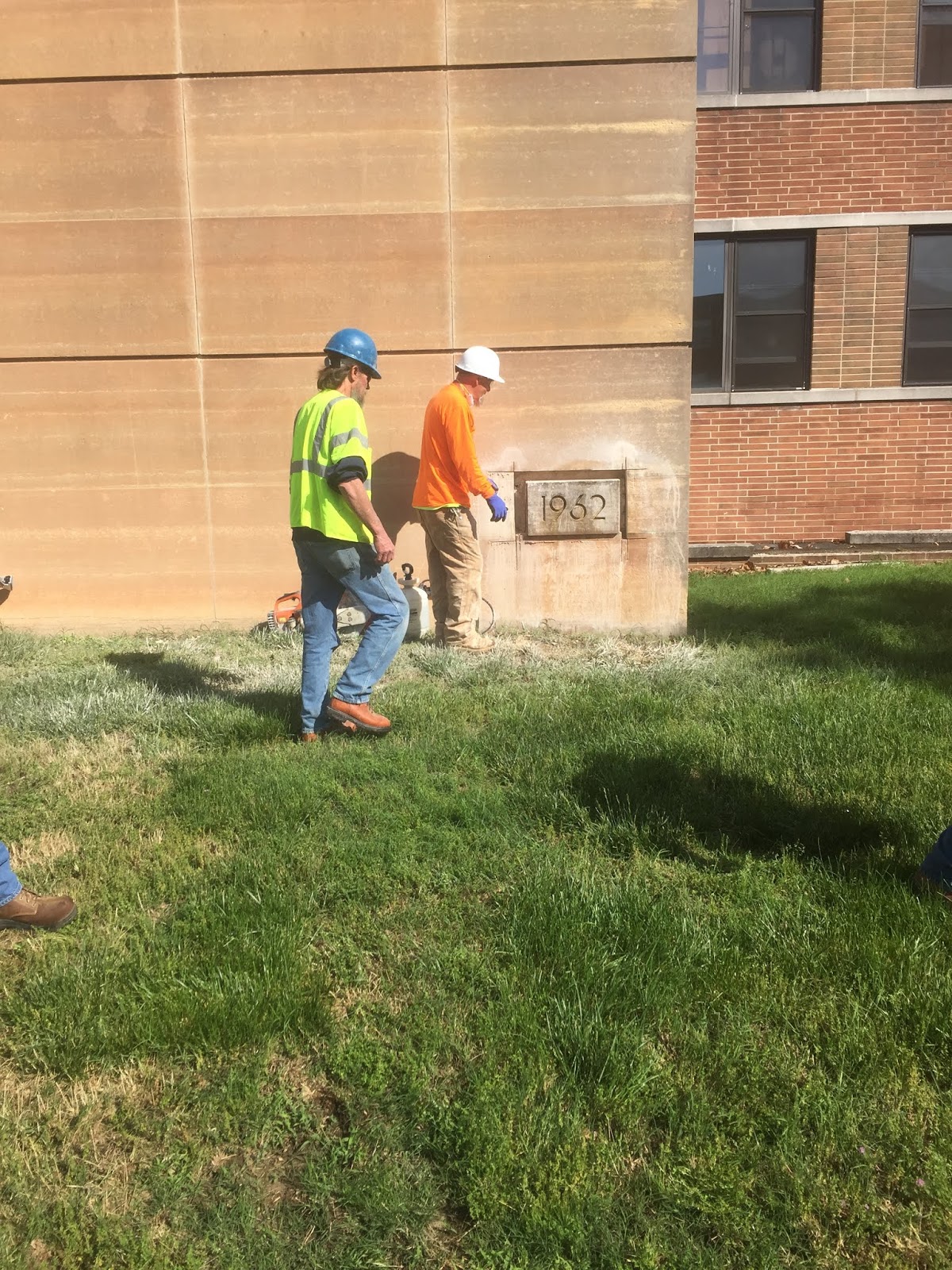
Laws Hall Time Capsule
It was tough work to crack open the soldered-shut box, but it served to build the anticipation.
"If the ghost of Lydia Laws comes out I'm gone," someone joked. Turning to me, "I like you so I might save you."
"As long as it's not bones, I"m good," said another.
"Yeah, right! It's the campus turtle or something."
"There's a snake in there!"
Friday, May 11, 2018
Lights Out at Laws Hall
Tomorrow afternoon from 1:00 to 3:00, we will be saying goodbye to a much loved residential hall. Laws Hall, constructed in 1962, is slated to be demolished this summer to make room for a new dormitory. You are invited to join us for this last opportunity to enter the building and to take a trip down memory lane. Refreshments will be served. Hope to see you there!
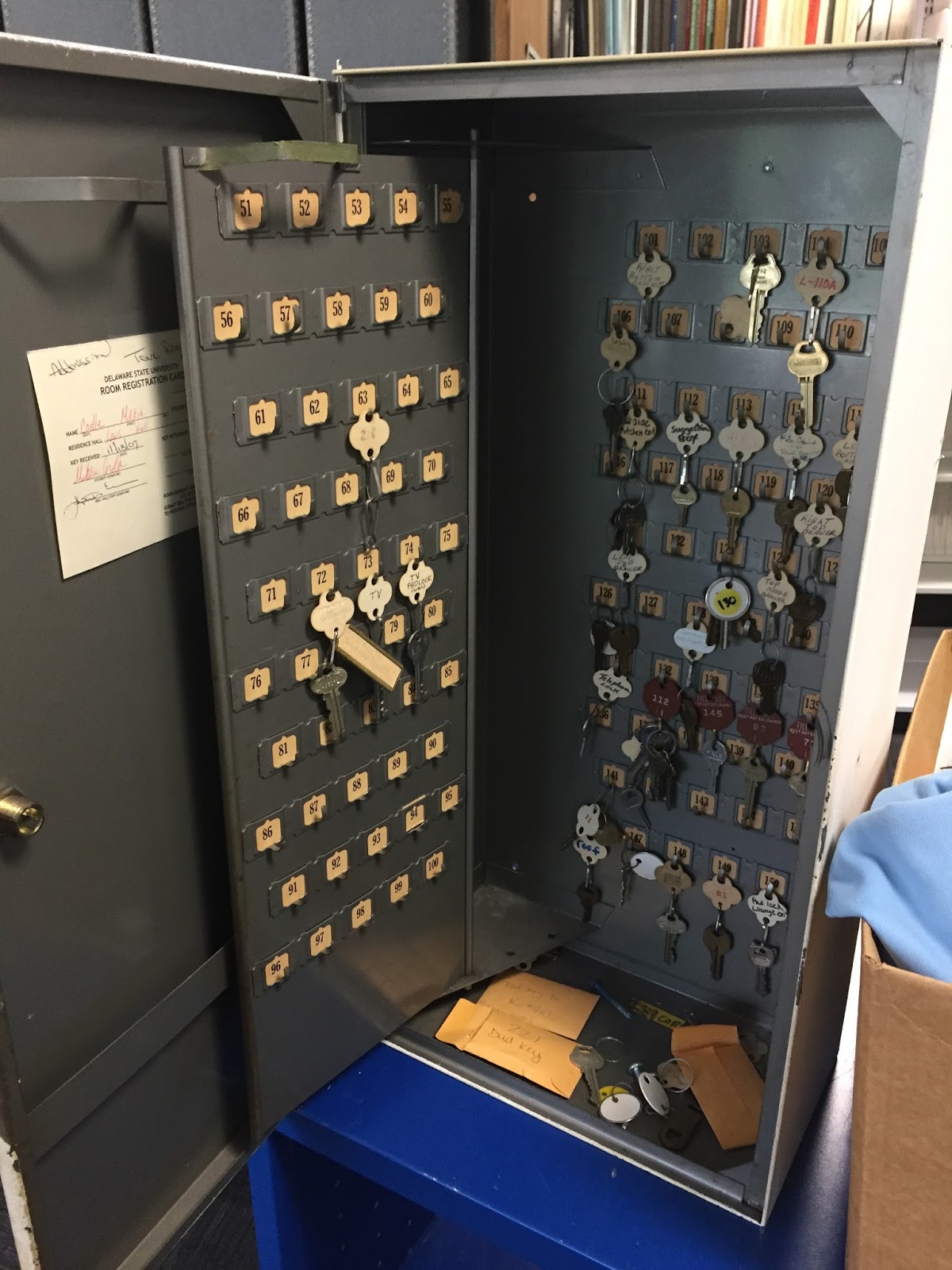
Yesterday, I, as the archivist, scavenged the building to transfer a few last treasures. Among them are a portrait of Lydia P. Laws,, the "Lovely Ladies of Laws Hall" welcome sign that hung over the entryway, a key box with building keys, RA log books, and a small amount of records. Do you have records or photographs of Laws hall? I would love to meet with you tomorrow.
Wednesday, May 9, 2018
Honorary Degrees
Congratulations to the class of May 2018! As commencement draws closer, I want to pause to consider the part of the ceremony frequently overlooked by excited graduates and their parents - the conferring of honorary degrees.
As a guest speaker draws to a close, the anticipation is palpable. But before the unending line of graduates can snake up the walkway to receive their degrees, the President must first honor the speaker or distinguished guests with an honorary degree.
What is an honorary degree? Most commonly, it is a doctorate degree awarded to someone who, although he or she has not completed the requisite coursework and assignments, has sufficient field experience to rival a formal education. The degree may also be awarded to someone who commands significant respect within the university community, such as emeritus faculty. The degree is typically referred to as a Doctorate of Humane Letters.
Here at Delaware State University, we have awarded honorary degrees to individuals from all walks of life. They include political dignitaries such as former Vice President Joe Biden, Benjamin Carson, or John Kofi Agyekum Kufuor, the President of the Republic of Ghana. Our past honorees also include cultural titans such as Queen Latifah and Bill Cosby. Check out the list of known recipients below.
1961: Martin Jenkins
1962: Sterling McMurrin
1963: Thomas Carroll; Walter Aiken
1964: Elbert Carvel; Julius Thomas; Logan Wilson
1965: Leland Hayward; James Nabrit
1966 Robert Weaver
1967 Stuart Udall; Bishop John D. Bright; Reverend Henry Herndon; Dr. Maurice Thomasson, Acting president of DSC
1968: Jack Robinson; William Ryan; Leon Sullivan; Asa Randolph; John McDowell
1969: Herman M. Holloway; Ercell Watson
1970: Harriet Williams; King Cheek; Harold Keller; James Baker; Jerome Holland, President of DSC
1971: John W. Lord; William McElroy; Norman Wilder
1972: Sister Mary Elise; James Cheek
1973: Barbara Jordan; Beatrice Henry
1974: Earl Jackson; Barbara Sizemore
1975: Maynard Jackson; Daniel James
1976: Carl Rowan
1977: Pierre DuPont; Walton Simpson; Paul Weatherly
1978: Julian Bond; W.R. Wynder, DSC faculty; William G. Dix, DSC staff
1979: Parren J. Mitchell; James C. Hardcastle, DSC Trustee
1980: Mary Frances Berry
1981: Nicholas H. Rodriguez; Ulysses S. Washington, Jr., DSC Faculty
1982: Walter Faunteroy
1983: Samuel R. Pierece, Jr.
1984: Terrel H. Bell; Crawford J. Carroll; John Robert Price (Posthumous), DSC faculty
1985: Marion Barry, Jr.; James Hazell Williams
1986: Michael N. Castle, Governor of Delaware; Louis L. Redding; Al O. Plant, Jr.
1987: Dr. Luna I. Mishoe; William Granville; Cora N. Selby, DSC Trustee
1988: John Lewis
1989: William H. Gray III, Mr. William H. Davis
1990: Juanita Kidd Stout, PA supreme court; Arthur E. Bragg, DSC Professor Emeritus
1991: A. Richard Barros, DE attorney
1992: Endsley P. Fairman, DE philanthropist
1994: Thomas Richard Carper, DE Governor
1995: Susan Taylor
1996: Benjamin S. Carson, M.d.
1997: Charles M. Cawley, MBNA America Bank
1998: Nikki Giovanni, poet; Dr. Billy Taylor, jazz historian; Edward Loper Sr., artist
1999: Johnnie L. Cochran, Jr., J.D.
2000: Dr. Bertice Berry
2001: Dr. William H. Cosby, Sr.; Clifford Benjamin Brown (Posthumous)
2002: Dr. Dorothy Irene Height
2003: Joseph R. Biden, Jr. US Senator
2005: James H. Gilliam Sr., President of Wilmington Housing Inc.
2006: Nathan Hayward III, DelDOT
2008: Clark Kent Ervin, J.D., Homeland Security
2011: Jeff Johnson, investigative journalist
2012: Warren Brown, CakeLove founder
2015: Ann Rosenberg, Global SAP University Alliances; John Kofi Agyekum Kufuor, President of the Republic of Ghana
2016: Denise Young Smith, Worldwide Human Resources for Apple; Jack Markell, DE Governor; Johnny C. Taylor Jr., Thurgood Marshall College Fund
2017: Lisa Blunt, US House of Representatives; Steve Ewig, Executive Officer of Wade Ford Dealership
2018: James McBride, writer
As a guest speaker draws to a close, the anticipation is palpable. But before the unending line of graduates can snake up the walkway to receive their degrees, the President must first honor the speaker or distinguished guests with an honorary degree.
What is an honorary degree? Most commonly, it is a doctorate degree awarded to someone who, although he or she has not completed the requisite coursework and assignments, has sufficient field experience to rival a formal education. The degree may also be awarded to someone who commands significant respect within the university community, such as emeritus faculty. The degree is typically referred to as a Doctorate of Humane Letters.
Here at Delaware State University, we have awarded honorary degrees to individuals from all walks of life. They include political dignitaries such as former Vice President Joe Biden, Benjamin Carson, or John Kofi Agyekum Kufuor, the President of the Republic of Ghana. Our past honorees also include cultural titans such as Queen Latifah and Bill Cosby. Check out the list of known recipients below.
![]() |
| The 1985 speaker, Mayor Marion Barry, Jr., arrives by helicopter from Washington D.C., May 19, 1985 |
1961: Martin Jenkins
1962: Sterling McMurrin
1963: Thomas Carroll; Walter Aiken
1964: Elbert Carvel; Julius Thomas; Logan Wilson
1965: Leland Hayward; James Nabrit
1966 Robert Weaver
1967 Stuart Udall; Bishop John D. Bright; Reverend Henry Herndon; Dr. Maurice Thomasson, Acting president of DSC
1968: Jack Robinson; William Ryan; Leon Sullivan; Asa Randolph; John McDowell
1969: Herman M. Holloway; Ercell Watson
![]() |
| Mayor Marion Barry, Jr. and entourage |
1971: John W. Lord; William McElroy; Norman Wilder
1972: Sister Mary Elise; James Cheek
1973: Barbara Jordan; Beatrice Henry
1974: Earl Jackson; Barbara Sizemore
1975: Maynard Jackson; Daniel James
1976: Carl Rowan
1977: Pierre DuPont; Walton Simpson; Paul Weatherly
1978: Julian Bond; W.R. Wynder, DSC faculty; William G. Dix, DSC staff
1979: Parren J. Mitchell; James C. Hardcastle, DSC Trustee
1980: Mary Frances Berry
1981: Nicholas H. Rodriguez; Ulysses S. Washington, Jr., DSC Faculty
1982: Walter Faunteroy
1984: Terrel H. Bell; Crawford J. Carroll; John Robert Price (Posthumous), DSC faculty
1985: Marion Barry, Jr.; James Hazell Williams
1986: Michael N. Castle, Governor of Delaware; Louis L. Redding; Al O. Plant, Jr.
1987: Dr. Luna I. Mishoe; William Granville; Cora N. Selby, DSC Trustee
1988: John Lewis
1989: William H. Gray III, Mr. William H. Davis
1990: Juanita Kidd Stout, PA supreme court; Arthur E. Bragg, DSC Professor Emeritus
1991: A. Richard Barros, DE attorney
1992: Endsley P. Fairman, DE philanthropist
1994: Thomas Richard Carper, DE Governor
1995: Susan Taylor
1996: Benjamin S. Carson, M.d.
1997: Charles M. Cawley, MBNA America Bank
1998: Nikki Giovanni, poet; Dr. Billy Taylor, jazz historian; Edward Loper Sr., artist
1999: Johnnie L. Cochran, Jr., J.D.
2000: Dr. Bertice Berry
2001: Dr. William H. Cosby, Sr.; Clifford Benjamin Brown (Posthumous)
2002: Dr. Dorothy Irene Height
2003: Joseph R. Biden, Jr. US Senator
2005: James H. Gilliam Sr., President of Wilmington Housing Inc.
2006: Nathan Hayward III, DelDOT
2008: Clark Kent Ervin, J.D., Homeland Security
2011: Jeff Johnson, investigative journalist
2012: Warren Brown, CakeLove founder
2015: Ann Rosenberg, Global SAP University Alliances; John Kofi Agyekum Kufuor, President of the Republic of Ghana
2016: Denise Young Smith, Worldwide Human Resources for Apple; Jack Markell, DE Governor; Johnny C. Taylor Jr., Thurgood Marshall College Fund
2017: Lisa Blunt, US House of Representatives; Steve Ewig, Executive Officer of Wade Ford Dealership
2018: James McBride, writer
Friday, April 27, 2018
Look who I found at MARAC
On April 12-15, I attended the Mid-Atlantic Regional Archives Conference (MARAC) in Hershey, Pennsylvania. It's always a pleasure to see my former supervisors, classmates, and colleagues. This time there was a pleasant surprise. Jasmine Smith, our IMLS intern, is all grown-up and has a job of her own. I took the opportunity to get to know more about her new career at the Library Company of Philadelphia.
Q: What is your new job?
A: My job is divided into two roles: reference librarian and specialist of African American history. My role as a reference librarian is to staff the reading room and answer general questions either via email, in person, or over the phone, whereas my role as the specialist is to answer complex questions relating to African American history. It is also my responsibility to page and shelve materials used by readers; familiarize new readers and fellows on how to use WolfPAC, fill out call slips, explain reading room procedures, and suggest research materials. I also manage the Facebook page for the program in African American history and assist with blog posts.
Q: What is your favorite part of working for the Library Company?
A: I am constantly surrounded by highly education scholars who are working towards future publications. I enjoy this aspect about my job because it allows me to increase my knowledge on subjects that I am unfamiliar with or have a different perspective on.
Q: Are there any interesting collections that you've worked with so far?
A: The Amy Matilda Cassey album is my favorite collection at the moment. Amy Matilda Cassey was a very prominent African American, middle-class woman who was involved with the anti-slavery movement in Philadelphia. Her friendship album dates from 1833 until 1856 and has signatures from activists and abolitionists such as William Lloyd Garrison, Frederick Douglass, Robert Purvis and more. This is an important document because it describes how life was for middle class African American men and women during a time of segregation.
Best of luck to you, Jasmine!
Some links of interest:
Monday, April 16, 2018
All my ducks in a row
For this one, bright, shining moment, I get to say that I have all my ducks in a row... but only because I have literal ducks in a row. Today the archives received a donation of ten waterfowl decoys created by Mr. Douglas A. Gibson '50.
Mr. Gibson has practiced his art form for more than 30 years and has received recognition at the Canadian Art Exposition and the Nur Temple. He has additionally been showcased at the Eastern Waterfowl Festival and the Ward Brothers Foundations' Best in the World Competition, both of which are "by invitation only" events. In 2004, he was invited to be the Delaware representative for waterfowl carving at the Smithsonian Folk Life Festival in Washington, D.C. When one sees his beautifully hand carved and painted birds, there's no question why.
The decoys will be made available for viewing and research. The birds depicted are:
- Mallard Drake, 2018
- Canada Goose, 2016
- Bald Pate Widgeon, 2004
- Canvas Back Drake, 2008
- Shoveler, 1993
- Scaup Blue-Bill, 2001
- Mallard Hen
- Carolina Wood Duck, 2014
- Green Wing Teal-Drake, 2008
- Green Wing Teal-Hen, 2013
Subscribe to:
Posts (Atom)