Tuesday, April 30, 2019

The Delaware State University Mace


The countdown to commencement is running with just ten days to go until we recognize the class of 2019. Also, shout out to the DSC class of 1969 who will be commemorating the 50 years since their graduation! 

At this moment the university is preparing the grounds, and we, the faculty, are pulling our regalia out of the closets. Among the heraldry being "spiffed up" is the university's academic mace (pictured above in 1986). 

The tradition of a ceremonial mace dates to the middle ages when the processional of a sovereign or high official would be marked by a proceeding mace-bearer. Today maces are most commonly seen in government and academic institutions.  The United States House of Representatives, for example, has a highly symbolic mace of 13 ebony rods held together by silver strands and is topped by a globus and eagle. 

Delaware State University's mace is simplistic in appearance but contains much symbolism.  It was designed and constructed in 1963 by John McCollough, an assistant professor of art education. It is reminiscent of traditional English ceremonial maces from the 14th century.  It is composted of a crowned globus to signify royal authority.  The mace is constructed from silver and wood from seven continents - ebony from Africa, lace wood from Australia, rosewood from Africa and India, mahogany from the Philippines, pear wood from Switzerland, lignum vitae from South American and walnut from North America.  The globus, or sphere represents the universe and the roles of art and science within it. The globus has a second meaning in that it is also meant to be symbolic of an atom.  The silver crown, shaped like a star at the top of the globus represents the increasing significance of the space and technology age (the mace was made in 1963 when NASA was only five years old). 

The mace was formerly carried by Dr. Ulyssess S. Washington who served as the university's grand marshal from 1953 until 2004. Thereafter, the title and the honor of bearing the mace was bestowed on Dr. Mable Renee Morrison, associate professor of music.  Dr. Morrison has been a highly respected faculty member for 57 years. On May 11, 2019 she will again lead the commencement processional just ahead of President Wilma Mishoe. 
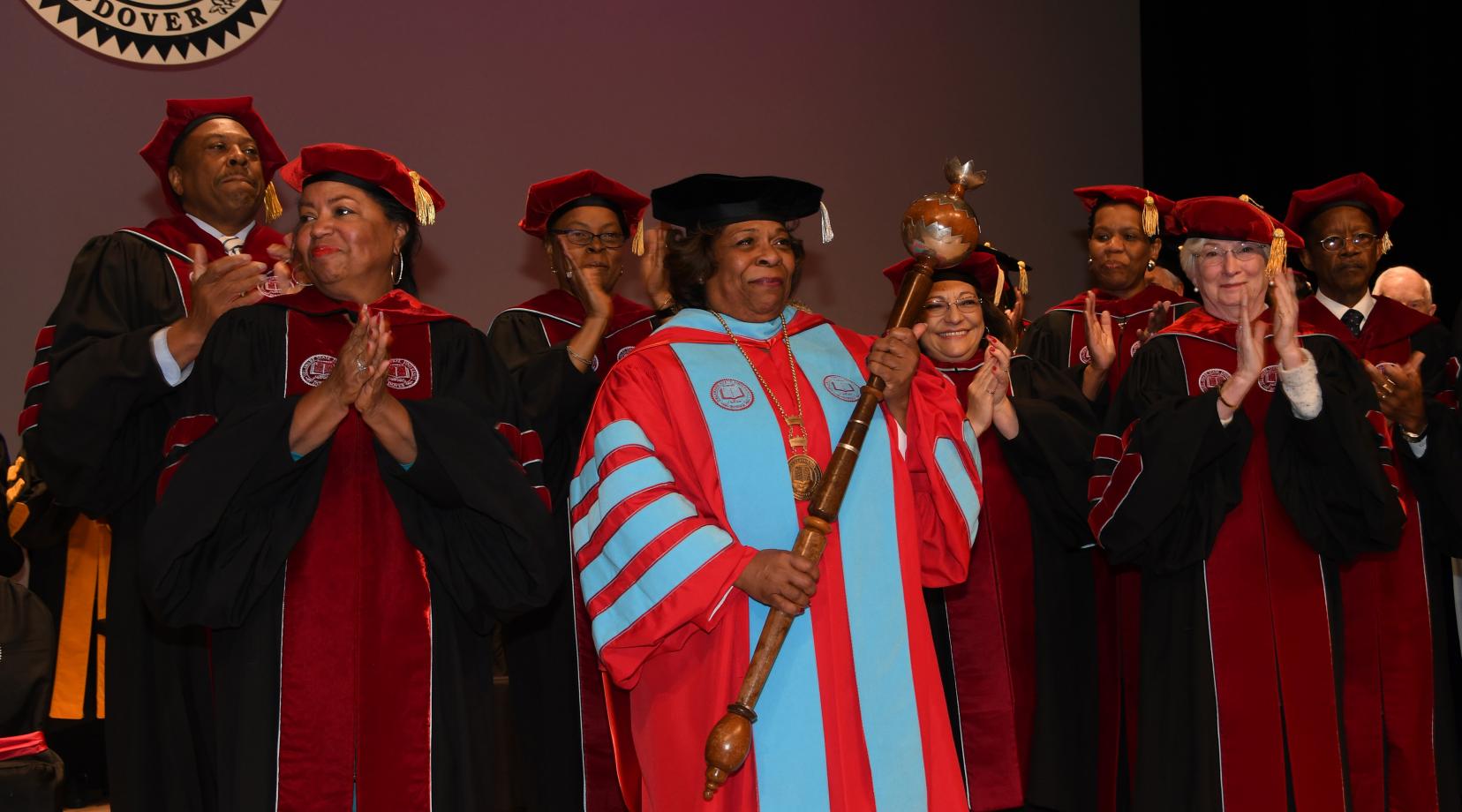
Image result for Dr. Wilma mishoe investiture
President Wilma Mishoe holds the mace on the occasion of her investiture ceremony on December 8, 2018. 

The mace at the 1969 commencement. 
Congratulations to the class of 1969 on your golden anniversary. 

Sunday, April 7, 2019

Happy National Library Week! April 7-13, 2019

Hello Friends! It's National Library Week! This year the American Library Association has chosen a theme of Libraries = Stronger Communities.  As ALA says, "Libraries are at the heart of our cities, towns, schools and campuses, providing critical resources, programs and expertise. They also provide a public space where all community members, regardless of age, culture or income level, can come together to connect and learn." Here at Delaware State University the William C. Jason Library is both the physical and intellectual intersection of campus. We are a link between science and art, social and academic, faculty and student, campus and community. We strive to serve all and we are proud to be your librarians.

In honor of Library week I thought we would take look at the history of the library and it's namesake:

The William C. Jason Library is named in honor of Delaware State University's longest serving president. President Jason's tenure, from 1895 to 1923, was punctuated by expansive growth of both the student body and campus infrastructure.  His achievement is fully appreciated with the recognition that, despite being a public school, financial support from Delaware State was initially insufficient.

In 1902 the Board of trustees approved President Jason's request to public ally raise $1,000 for campus improvements.  The president's fundraising efforts took the form of a speaking tour that resulted in 700 pledges largely received from the African American community.  While the pledges totaled $1,112, regrettably, only $533 was received.

The money was frugally applied to the construction of a chapel (left).  In lieu of hiring laborers, the professors of the industrial arts program developed courses around the chapel's construction. Additionally, bricks from the slave quarters of the Loockerman plantation were recycled to lessen the cost of materials.

By the 1920's the perpetual pattern of college-wide growth required the chapel to be converted into a library.  Further growth resulted in the construction of the current library in 1975 with an addition in 1991 (below). The early chapel structure, now known as the Thomasson Building, remains today and can be found at the end of the campus mall.
The expansion of the current William C. Jason Library in 1991. 

Thursday, March 28, 2019

This month in History: March 1966 response to NAACP resolution

On February 23, 1966 the Delaware State Conference of the National Association for the Advancement of Colored People, NAACP, issued a resolution stating "We contend that education provides the fundamental medium for the perpetuation of segregation and discrimination in our society. Delaware State College continues as this medium of injustice."  It accused DSC of "tokenisum" by virtue of the small number of white students. Furthermore, the resolution calls for the closure of Delaware State College in order to perpetuate the integration of University of Delaware which was begun in 1950.

The letter bearing the resolution was sent to DSC President Mishoe by Littleton P. Mitchell, President of the Delaware State Conference of NAACP.  Mitchell had been a member of the NAACP since he was thirteen.  In the 1930's he completed high school at Howard High and spent two years at West Chester University of Pennsylvania on an athletic scholarship. His collegiate education was cut short when he joined World War II as a flight instructor for the Tuskegee Airman.  I personally wonder how these experiences, attending a segregated high school and serving the US Army in a segregated unit, must have impacted him. Mitchell became a formidable force for the NAACP and served as a conference president for more than thirty years. Among his many accomplishments he successfully led the movement for the desegregation of Delaware hospitals.

In March of 1966, after receiving the NAACP resolution,  President Luna I. Mishoe was obviously dismayed with its message. He drafted a thirteen page special report to the Board of Trustees and painstakingly responded to every accusation Mitchell had publicly laid against Delaware State College.  His chief message was "From all evidence available to me, this College is at least 10% integrated and the chart is still moving upward.  This cannot be accurately called tokenism when most of this happened within the past THREE years...Our faculty is more than 30% integrated."

To me, what is interesting is that today's society commonly perceives the NAACP as fighting against white institutions that barred blacks. What this resolution reminds us is that the NAACP fought against all segregation. In fact, the NAACP resolution states, "It is our position that each of Delaware's institutions of higher learning is segregated...As a result, therefore, Negro and white students of both institutions continue to receive an inferior education." I don't wish to speak for Littleton Mitchell, but what I would like to think he was conveying is the idea that students of any race cannot learn from each other's experiences if they do not learn together. 


The NAACP resolution may be viewed in the Harriet R. Williams Collection; box 2; folder 5, part 2.  If you would like to study the current statistics on the make-up of the student body you may be interested in the Delaware State University Factbooks viewable at https://www.desu.edu/academics/academic-affairs/institutional-effectiveness/institutional-research-planning-analytics/fact-book

Monday, March 25, 2019

Department of Nursing Records Acquired

This month the archives acquired a substantial number of records from the nursing department. I am very pleased to say that this is a valuable and surprisingly complete acquisition. 

Up to this point in my tenure at DSU I have acquired the bulk of the archives' records from basements and abandoned closets.  Consequently, I am accustomed to working with collections that are frequently disjointed, have large gaps in data, lack provenance, or are disheveled to the point that they cannot be pieced together. I am pleased to say that in the case of the Department of Nursing records it was the quite the opposite! The records were shockingly well-ordered and made my job nearly effortless.

The nursing collection is complete in the sense that it contains a nursing degree program proposal from 1972 when the idea for a nursing course was first conceived. The development of the department through the 1970s may be clearly seen through written proposals, funding requests, and supporting documentation.  Additionally, patrons will be able to clearly trace the history of department through a large number of reports drafted for accrediting institutions and the Delaware Board of Nursing. All in all, while gaps do exist (primarily for the 1980s) they are not extensive.

I'd like to give a huge shout out to the Nursing Department for making this big step forward! The faculty and senior secretary deserve recognition for their clear appreciation for history.  Not only were the records well organized, but the department sought me out.  I did not have to cajole them into transferring records.  Rather, they were eager to contribute and recognized the benefits for all parties involved. Thank you Nursing Department!

Patrons may view the finding aid on the archive's LibGuide at https://desu.libguides.com/c.php?g=548691&p=3764808.

Monday, February 18, 2019

Delaware State College/University Yearbooks now being Digitized

Visit the digitized University Archives at: https://desu.dspacedirect.org/handle/20.500.12090/348
 I am excited to announce that the DSU archives has launched a new tool for sharing digitized content and making it just a little bit easier for long-distance patrons to access archival collections.  DSpace is a digital repository or what could be described as a virtual representation of the physical archives. Although it will take some time, the most prominent collections of the DSU archives will be digitized and made available online. 

Last month I conducted a survey of 50 constituents to learn how you, the users, might use the repository and to determine what content would be most valuable.  The overwhelming majority (90% of participants) specified that yearbooks would be the most useful collection.  As a result, I made the digitization of the yearbooks a top priority.  To date, the 1985-2007 yearbooks have been digitized and uploaded to the repository.  More are on the way! You can view them here.

Thank you to all who participated in the survey.  Please know that your input is valued and I will do my best to meet your requests.  If you didn't participate in the survey but would like to comment or offer suggestions you can do so in the comments below or email me at rscherry@desu.edu. Any feedback is welcome. 

Lastly, the archives has several gaps in the yearbook collection.  I would love to hear from you if you possess or have any information about the Statesman yearbooks listed below.  Even if you are not willing to be parted with your yearbook, would you consider loaning it so that may be digitized?
  • any Statesman made prior to 1960 except for 1947
  • 1962 Statesman
  • 1963 Statesman
  • 1964 Statesman
  • 1965 Statesman
  • 1977 Statesman
  • 1978 Statesman
  • 1984 Statesman

***3/18/2019 UPDATE: All of the yearbooks have now been digitized.  https://desu.dspacedirect.org/handle/20.500.12090/348

Monday, February 4, 2019

#ColorOurCollections


Each year the New York Academy of Medicine hosts a #ColorOurCollections imitative.  Participating archival and library institutions submit digitized coloring books composed of  sketches and artworks found within their collections.  Patrons are encouraged to color the images and post them to Twitter with the hashtag #ColorOurCollections. You can view the coloring books at https://library.nyam.org/colorourcollections/

Although the Delaware State University Archives is not a formal participant in the movement, I thought it would be fun to offer you a similar opportunity. Share your artworks @desu.library and  #ColorOurCollections. I can't wait to see your artistic skills.

Below: This artwork was scanned from the 1976 Statesman yearbook.  The artist is Allen Smiley  who was a Freshman at the time of publication.


Wednesday, January 16, 2019

Found: Harriet R. Williams research notes


While sifting through some of the remaining unprocessed collections I came across a box full of handwritten notes on yellow notepads.  Each note contained cramped, cursive handwriting that filled the entirety of the page with notations about the history of Delaware State College.  At first glance there was no identifying information to be able to know to whom the research belonged. However, a second flip through the pages revealed clues - reminders about hair appointment, the chemistry club, and Administrative Council meetings.

It became evident that this was the work of Harriet Ruth Williams, a chemistry professor and prominent university figure from 1941 until c. 1993.  She is the second-longest serving professor in the history of the university and was a central figure in the growth of the science department during Luna I. Mishoe's early presidency. She additionally served the university as an administrator for public relations, alumni relations, admissions, and academic affairs to name a few.

Toward the end of her career and into retirement Dr. Williams had been compiling a comprehensive history of then-Delaware State College with the hopes of writing a book. She never completed the book and for a long time the location of her research notes was unknown to us.  Myself and campus historians believed them to be forever gone.

It therefore with great pleasure that I announce the existence of the notes and drafts for what appears to be "Chapter One" of Dr. Williams' manuscript.   The research primarily discusses the history of the Loockerman Family, Morrill Acts, and the incorporation of the college.  There are additionally scattered notes for the Webb and Gregg presidencies.  If you would like to view the full finding aid for the collection you may find it on the archives LibGuide or at https://desu.libguides.com/ld.php?content_id=46335455

.

Tuesday, January 8, 2019

Mr. Townsend and the Polish Prince by Mike Gastineau

The DSU archives is celebrating yet another landmark achievement! For the first time ever, the archives and I, by name, have received acknowledgement in a book.

Last year Mr. Mike Gastineau visited the William C. Jason Library to conduct research regarding the 1981 DSC football team and its controversial coach, Mr. Joe Purzycki. At that time he examined Board of Trustee records, news clippings, and sports media guides. These records, in conjunction with conversations with Mr. Purzycki, led to a book.

Mr. Townsend and the Polish Prince tells the story of the racial tensions that resulted from an unprecedented move by Delaware State University to hire a white coach football. After a embarrassing 1980 season, concluded by a 105-0 loss to Portland State University, the then-athletic director, Nelsen Townsend, decided a radical change was necessary. Townsend hired Purzycki, the assistant football coach at University of Delaware.

When Purzycki came to work on his first day, he had to force his way through a picket line of students protesting his presence on campus and seventeen scholarship players immediately quit the team. Despite these and numerous other challenges, Purzycki won the admiration of the DSC community and ultimately turned the team around.

I haven't read Mr. Townsend and the Polish Prince, yet, but I am eager to begin.  This a chapter of University history that I was hitherto unaware of, and I'm grateful to Mr. Gastineau for bringing it to the limelight.

If you'd like to learn more about this story you can checkout the book's website at https://thepolishprince.com/ or you can purchase the book on Amazon.  It is available in both paperback and kindle editions. https://www.amazon.com/Mr-Townsend-Polish-Prince-redemption/dp/1728922488

Congratulations Mr. Gastineau and Mr. Purzycki!

Monday, December 10, 2018

Annual Christmas Letter, 2018

Dear Archives Friends,

Have you ever wondered where the Ghost of Christmas Past, Present, and Future live? My guess is that they hang out in an archive somewhere.

Although most people would think of an archives as serving the past, in actuality they influence the present to affect the future. Archival institutions document events as they unfold so that, in future, the records may be utilized and the events understood. By providing documentation of the past to university leaders as they shape the future, and by educating students about our history, the archives played a definitive role in the continuance of tradition and the understanding of legacy (the theme of President Mishoe's inauguration this past Saturday). In essence, archives are where the past, present, and future are exist harmoniously.

Throughout 2018 the DSU archives has proudly stood in sidelines supporting and cheering on the broader university.  This year the university celebrated major milestones and commemorated it's past:
  • April - The 50th anniversary of the 1968 student demonstrations
  • May - The commemoration and closing of Laws Hall
  • July - The 25th anniversary of the name change from DSC to DSU
  • December - The investiture of the 11th President, Dr. Wilma Mishoe 
For each of these significant events, the University Archives received and facilitated reference requests.  Among the topics researched were the personage of Lydia P. Laws, the legacy of the 1968 demonstrations, administrative records about our name change, how the shift to a university jump-started growth in student population and academic programs, and lastly, the legacy of President Luna I. Mishoe (1960-1987). From each of these research areas the university gleaned data in order to construct a public dialogue about who we have been and what we will continue to stand for on the outset of a new era.

Thank you for joining me on this adventure for another year! Here's to the many more to come.

Cheers,
Joy

Wednesday, December 5, 2018

Archival Photos in MLKSC

Guess what!  Archival photographs are now on permanent display in the pool hall in the  Martin Luther King Student Center.  

A few months ago the Director of Wellness, Recreation and Campus Events asked me to collaborate with her on the installation of historic photographs in the MLKSC. We wanted the students to have an opportunity to see and appreciate the legacy that they are a part of.  Showing them student faces from the very beginning (c. 1915) until the recent past seemed like the best way forward. Plus, I'll admit the hair styles from back in the day have entertainment value.

The images included show sorority and fraternities, athletic events, student organizations, former Miss Delaware State College contestants, and student life in general. Next time you're in the Martin Luther King Student Center take a look!